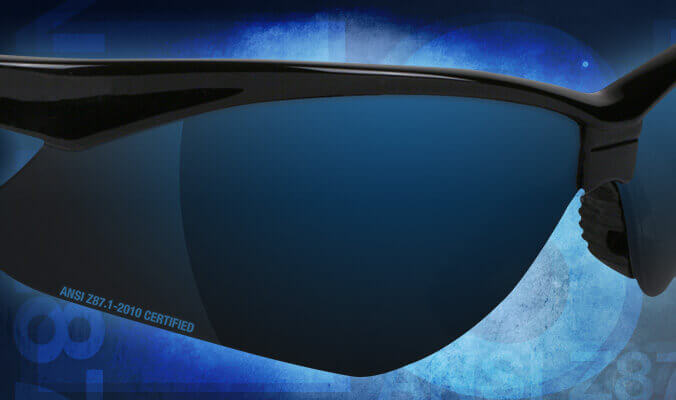
ANSI Z87.1 Defined
The American National Standards Institute (ANSI) is a nonprofit organization with a primary mission to enhance the global competitiveness of U.S. businesses and the U.S. quality of life by promoting and facilitating voluntary consensus standards and conformity assessment systems, and safeguarding their integrity.
In other words, ANSI establishes uniform testing standards and guidelines for various products and equipment used by businesses across nearly every sector.
The Z87.1 portion of the ANSI standards references the Occupational and Educational Personal Eye and Face Protection Devices standards. These standards help ensure that personal eye and face protection devices provide the necessary protection from impact, non-ionizing radiation, and liquid splash exposures.
ANSI Z87.1 General Requirements
The ANSI Z87.1 certification provides a structured system for addressing encountered hazards. With this standard, the choice of safety eyewear centers on the protection required for the specific hazards encountered in the workplace. The most common hazards are:
- Blunt impact
- Radiation
- Splashes and droplets
- Dust
- Small particles

The Z87.1 standard uses high-mass and high-velocity impact tests, among others.
Most safety eyewear manufacturers provide packaging and information indicating how products meet ANSI Z87.1 standards. Prescription safety lenses that meet high-impact testing requirements are also allowed under the standard.
ANSI Z87.1 2020 Update
Past updates to the ANSI Z87.1 standard have focused on product performance and harmonizing with International Safety Equipment (ISEA) standards. They've made it easier for users to select the appropriate safety gear based on the potential hazards and complications their environment produces. The 2015 update also clearly defined UV radiation and addressed issues related to emerging technologies.
The Z87.1 2020 update also addresses product innovations and continues ANSI's focus on product performance and harmonizing with ISEA standards. It emphasizes the importance of wearing the proper protection for the specific job or "matching the protector to the hazard."
For example, workers who require vision correction should not assume that everyday prescription glasses provide the same protection as ANSI-certified safety eyewear. Frames marked "Z87-2" indicate prescription safety glasses, while "Z87-2+" identifies prescription safety eyewear that meets high-impact requirements. Under the updated marking system, these distinct markings help identify eyewear designed to provide both vision correction and workplace protection, making it easier to select the right Safety Eyewear for the task at hand.

Since the 2015 update, the ANSI/ISEA Z87.1-2020 standards underwent the following changes:
- Criteria and requisite markings for protectors now offer relaxed optics as an option.
- Testing, performance, and marking criteria for anti-fog lenses were added to minimize potential harm caused by workers removing or adjusting protective eyewear due to foggy lenses.
- Transmittance allowances were changed.
- Welding filter shades were expanded, and the updated standard addresses the new and innovative product designs, offering additional protection and enhanced benefits.
- Clarifications were added to promote consistency in testing dark-state tolerances for automatic darkening welding filters and determining the minimum coverage area concerning the specified headform.
See ANSI Z87.1 Eye and Face Protection Devices Standard for more information on past revisions. For the full 2020 update, read the complete ANSI-ISEA Z87.1-2020 Standard.
ANSI Z87.1 Testing Processes

ANSI Z87.1-certified eyewear must pass a high mass impact and lens penetration test.
Safety eyewear undergoes intensive testing to ensure it meets ANSI Z87.1 standards and protects your eyes as expected. Tests include:
- Basic and high-impact for lenses and frames.
- Exposure to non-ionizing radiation and chemicals.
- Durability to flammables and corrosion.
Edge Eyewear gives An Inside Look at high-impact compliance testing to help you understand the impact testing process. After seeing how badly non-ANSI Z87.1-rated eyewear fails these basic tests, you'll want to purchase only ANSI Z87.1-rated eyewear.
ANSI Z87.1 Product Markings

New marking standards require manufacturers to label lenses with certain specifications.
The ANSI Z87.1 standard requires efficient and easy-to-understand lens and frame markings. The markings listed below make the selection process more straightforward and increase compliance.
- Z87+ is a high-velocity impact rating
- Z87 alone is the basic impact rating
- D3 indicates splash and droplet protection
- D4 indicates protection from dust particles
- D5 indicates protection from fine dust
- W plus a shade number shows the level of welding protection
- U plus a scale number shows the level of UV protection
- R plus a scale number shows the level of infrared light protection
- L plus a scale number shows the visible light filter
- Z87-2 on the front of the frame and both temples indicates prescription eyewear
- H indicates a product designed for smaller head sizes
- V indicates photochromic lenses
- S indicates a special lens tint
- X indicates eyewear has passed the fog test and can resist fogging
Rx Spectacle Ratings
- Manufacturer's mark or logo on frame or lens
- + symbol on lenses indicates they're impact rated
- Z87-2+ on the frame.
- Z87+ on detachable side shields if equipped
Prescription frames also require size markings on frames and temples, and all ANSI Z87.1-2020 safety eyewear markings must be permanently and clearly marked on frames or lenses. This marking requirement includes goggles, face shields, and safety glasses.
Product Marking Example

Example of Z87.1 lens marking specifications.
The image above shows a pair of Bolle Safety Glasses with ANSI Z87.1-2020 product marking requirements.
- Z87+ indicates eyewear meets the high-velocity impact requirement.
- U6 means the eyewear has a UV rating of 6, the highest rating
- S indicates a special lens tint because these glasses feature Bolle's ESP lens
You may encounter safety eyewear with only the Z87 mark, or with the manufacturer's mark and a + stamped on the lens or frame. These products were produced before or after the 2010 standard and are safe to use. They still meet ANSI Z87.1 high-velocity impact safety standards, but don't have updated product marking requirements.
Eye protection is a serious business. Workers in almost every industry are exposed to hazardous conditions that cause serious eye injuries daily. Proper safety eyewear, in accordance with the current ANSI Z87.1-2020 safety standards and combined with 100% compliance with a mandatory eye protection program, helps protect workers worldwide.